
Getting Involved in Research at CMU
by Sonali S.
When I first came to Carnegie Mellon University, I knew I was interested in engineering, but I wasn’t completely sure what direction I wanted to take. As I began exploring different classes and disciplines, I realized that the intersection between materials science and biology fascinated me the most. That realization eventually led me to pursue a primary major in materials science and engineering (MSE) with an additional major in biomedical engineering (BME). At the overlap of those two fields lies one of the most exciting areas of research today: biomaterials.
Biomaterials combine elements of engineering, medicine and biology. They are materials designed to interact with the body, whether that’s scaffolds for tissue engineering, implants, drug delivery systems or regenerative medicine technologies. The idea that materials could be engineered to heal the body or help regenerate tissue was something that immediately captured my attention.
My first interaction with this field at CMU came through my Introduction to Biomedical Engineering course with Professor Rosalyn Abbott. Beyond teaching the course, Professor Abbott also conducts research in biomaterials, which made the class even more exciting for me. Hearing about the kinds of problems researchers were tackling, like designing materials that mimic biological tissues or interact safely with cells, made me realize that I wanted to get involved in research myself.
During the fall of my sophomore year, I worked up the courage to reach out to Professor Abbott and express my interest in joining her lab. At the time, however, she explained that students typically needed to complete training in the lab over the summer before working there during the academic year. While I was a little disappointed at first, I also appreciated how structured the process was. It meant there was a clear pathway to getting involved if I remained interested.
Fast forward to the end of my sophomore spring semester, I decided to reach out again. This time, I asked whether I could join the lab over the summer. Fortunately, everything aligned perfectly and I was able to receive a SURA (Summer Undergraduate Research Apprenticeship) and spend the summer working in Professor Abbott’s lab.

That summer was my true introduction to research. Instead of just learning about biomaterials in lectures or textbooks, I was able to see firsthand how research actually happens through experiments, troubleshooting, collaboration and constant learning. One of the most impactful parts of the experience was working closely with my mentor, PhD student Nate Roblin. Having a mentor in the lab made an enormous difference in my learning experience. Nate took the time to explain not only how to perform experiments, but also why we were doing them and how they connected to larger research questions. Through his mentorship, I gained technical skills, confidence in the lab and a much deeper understanding of biomaterials research.
The project I’ve been working on focuses on controlling the degradation rate of silk-based biomaterials. Silk is a fascinating material in the biomaterials field because it is biocompatible, mechanically strong, and can be engineered for a wide variety of medical applications. One of the key challenges researchers face is controlling how quickly the material degrades once it’s inside the body. If it degrades too quickly, it may not provide enough structural support for tissue regeneration. If it degrades too slowly, it could interfere with the body’s natural healing processes. My work involves studying ways to tune that degradation rate so the material behaves in an optimal way for biomedical applications.
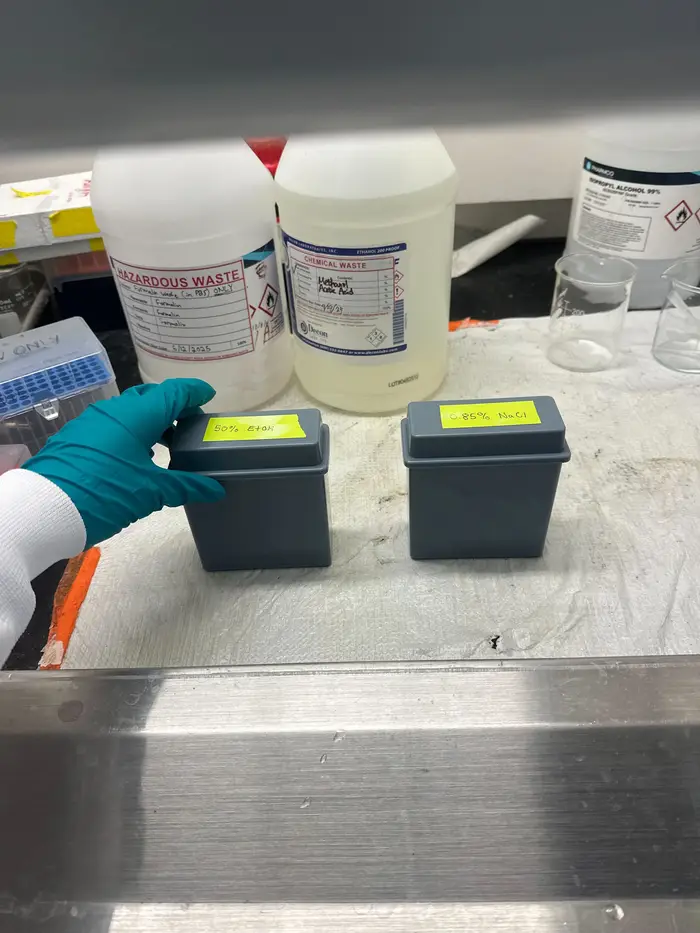
Working on this project has taught me so much, not just about silk biomaterials, but about the research process as a whole. I’ve learned how to design experiments, analyze results and think critically about why something worked or didn’t work. I’ve also learned that research rarely goes exactly as planned. Experiments fail, results can be unexpected and troubleshooting is often a huge part of the process. But those challenges are also what make research exciting, because every problem you solve brings you closer to discovering something new.
After the summer ended, I was grateful to continue working in the lab during the academic year, and I’m still involved in the research now during my junior spring. Being able to stay with the project long-term has been incredibly rewarding because I’ve been able to see my own growth as a researcher. Tasks that once felt intimidating, like running experiments independently or interpreting complex data, have gradually become part of my routine.
When I first started college, I wasn’t necessarily thinking about pursuing a PhD. But after spending time doing research and seeing how meaningful and intellectually stimulating it can be, I’ve started seriously considering that path. The idea of contributing new knowledge to the field of biomaterials and developing materials that could one day improve or save lives, is incredibly exciting to me.
Looking back, I’m really glad I took the initiative to reach out and pursue research opportunities. Getting involved in a lab can feel intimidating, especially as an undergraduate, but my experience has shown me how rewarding it can be. If you’re a student at CMU who is even a little curious about research, I would encourage you to explore it. Talk to your professors, ask about their work and don’t be afraid to express interest. Sometimes the path isn’t immediate, but persistence can pay off.
For me, that curiosity about the intersection of materials science and biology led to an incredible research experience, an amazing mentor and potentially even a future career path. And it all started with simply asking how I could get involved.